This is an explanation of the inside of the MesAmérica Resiste graphic project. READ the explanation of the Top Down perspective here.
The View from below: A grassroots perspective
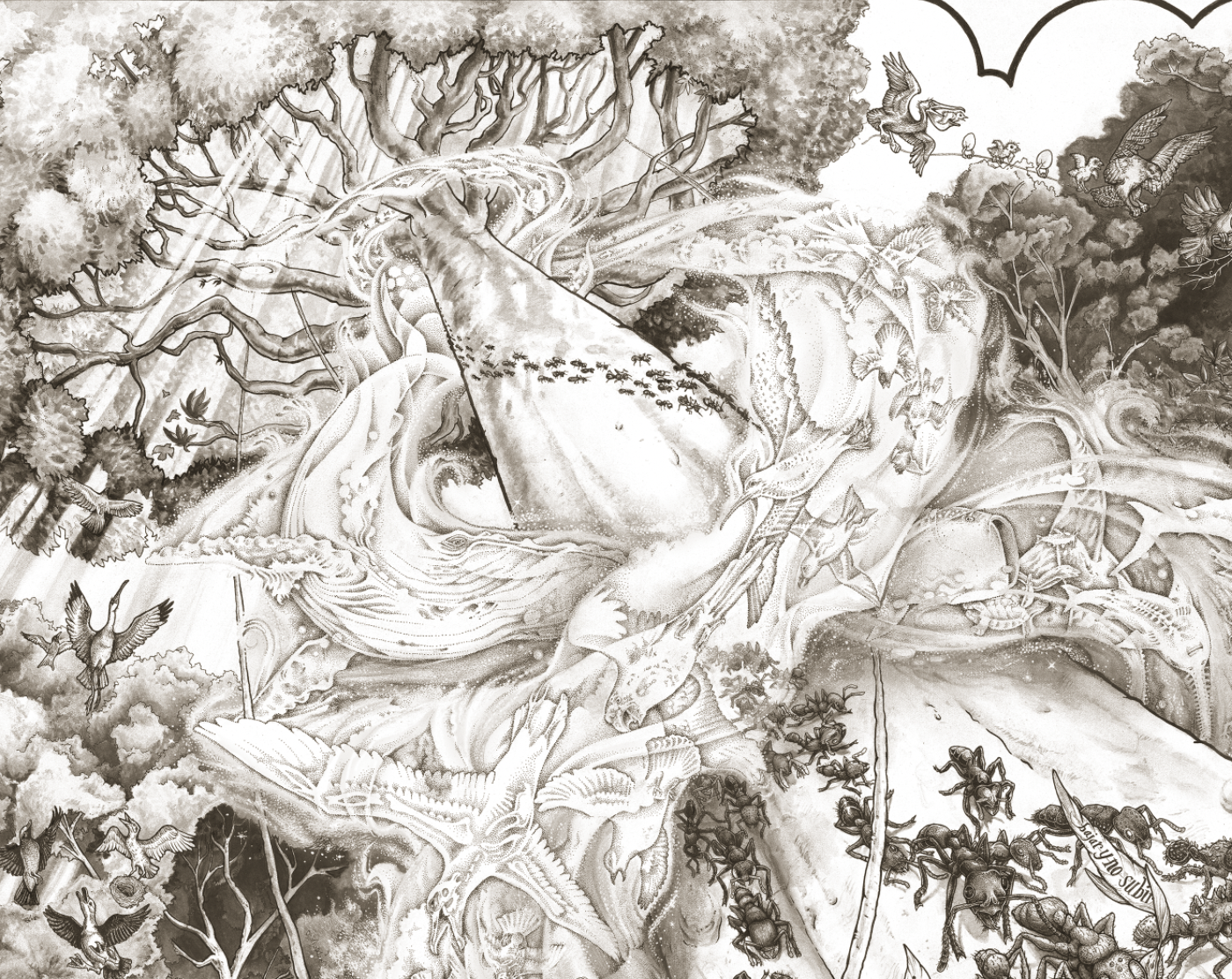 When you open up the poster, you get a completely different perspective. Rather than the outsider’s view of the colonial map, you are on the forest floor amongst the bugs and animals, looking up at a giant Ceiba Tree. The Ceiba tree is considered the Tree of Life in Guatemala, and is sacred in all MesoAmerican cultures. Spiralling around the tree like DNA strands are two streams of winged and water creatures. These are the spirit animals, drawn as creatures that are endangered or extinct from the region. They represent the presence of ancestors, to highlight this presence in MesoAmerican cultures and also to honour the contributions of ancestors to a multi-generational struggle against colonization.
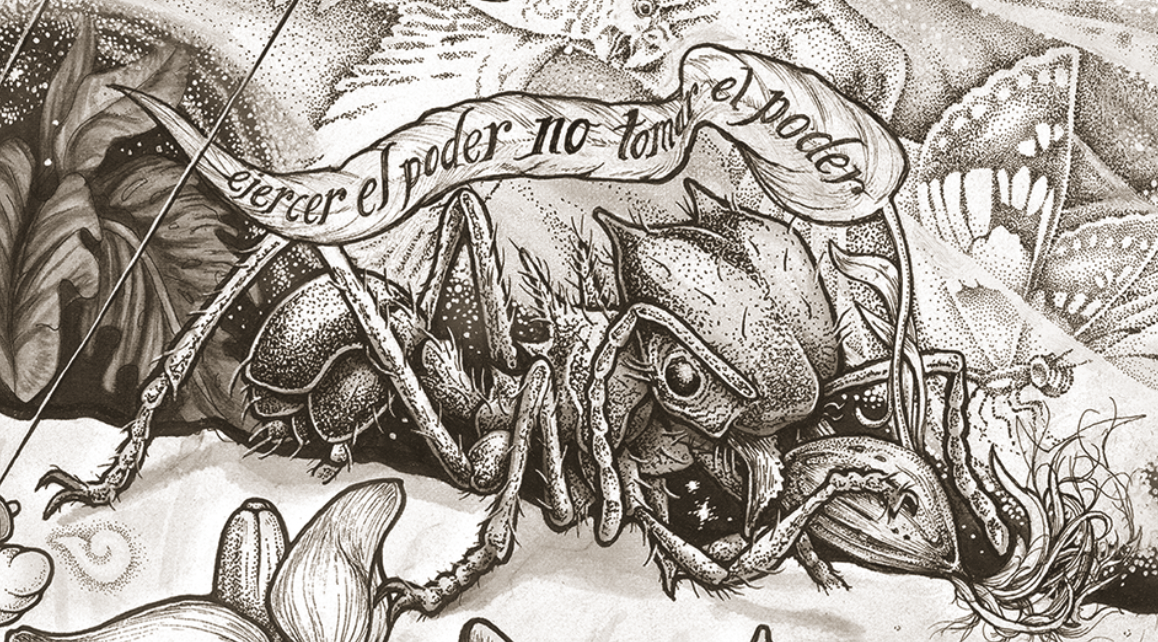 Also spiralling around the tree are over 70 different species of ants. In contrast with the monovision of development depicted on the outside of the graphic, the internal scene depicts over 500 different species of animals and plants, almost exclusively from the MesoAmerican region. These ants are carrying blades of grass that have the Zapatista principles of organizing written on them.
The Zapatistas
 The Zapatistas are an Indigenous autonomist movement in Southern Mexico who identify as anti-capitalist and feminist. They stepped onto the world stage on January 1, 1994 when they occupied several cities in Chiapas and declared war against the Mexican government with an army that no one knew existed, that they had developing in secret for the 10 years prior. But, it is important to note that one of their principles is “to exercise power, not to take it”, so they did not seek to take over the institutions which they occupied. In fact, declaring war was a tactic to get peace, as their supporters around the country mobilized mass demonstrations demanding that the government sign peace accords, which were signed but never ratified with the Mexican government. Since the initial ceasefire was negotiated, the Zapatistas developed autonomous communities throughout Chiapas.
Their principles read like poetry: “To command by obeying” “To walk by asking”, “to propose and not impose” and “to convince and not conquer”. They speak to a system of governance where the highest level of decision-making is the assembly, where all Zapatistas are allowed to participate.
As of Nov 2023, the Zapatistas disbanded the autonomous municipalities due to targeted cartel violence, though their administrative and economic centres, known as caracoles, are still open and play a role in the community.
The Cultural Scenes
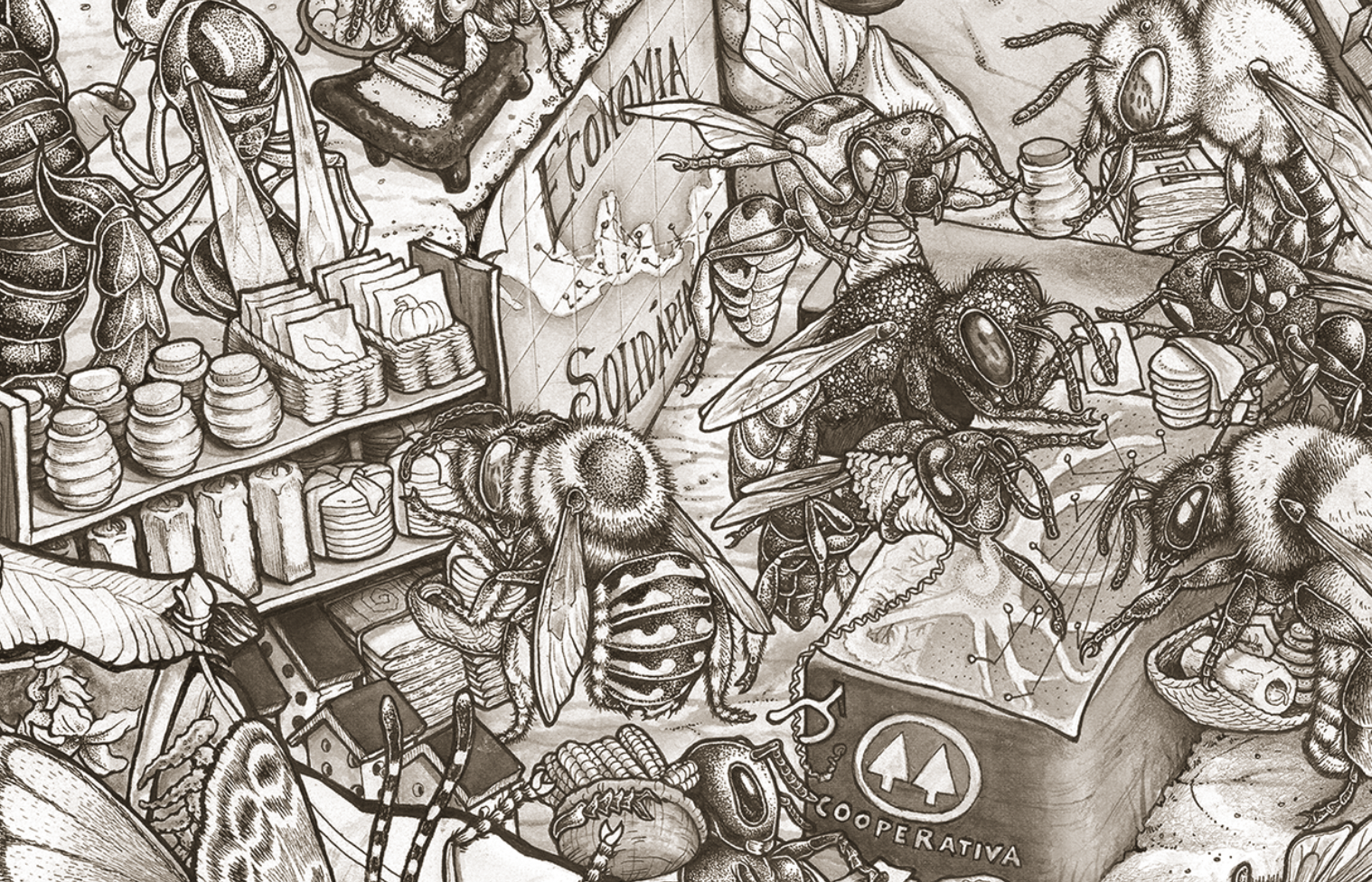 Within the roots of the Ceiba tree, you can see many scenes of cultures, including a scene dedicated to the solidarity economy. Traditional uses of water, a birthing scene, a fiesta, archiving historic memory, a community radio station, and a scene dedicated to illustrating a solidarity economy.
The Traditional Market
In this traditional market scene, all the merchants are pollinators, and they are paired up with the plant that they pollinate. So, the Yucca moth is selling yucca at the market, and the fruit bat is selling papaya smoothies that it is making on its pedal powered blender. Meanwhile, all of the customers are seed dispersers, so it is their job to poop out seeds encased in fertilizer. So, the system of pollination and seed dispersion becomes a metaphor for the role of a traditional market within an ecosystem — the buying and selling of organic food and seeds. And the strength of this market is represented by the DNA, or the biodiversity it upholds. But this DNA is being threatened by these shopping carts filled with monocultures of GMO soy, GMO corn, and palm. To the right, the market is being raided by processed food, and it is being held back by a make-shift blockade made of all of the trash associated with processed foods.
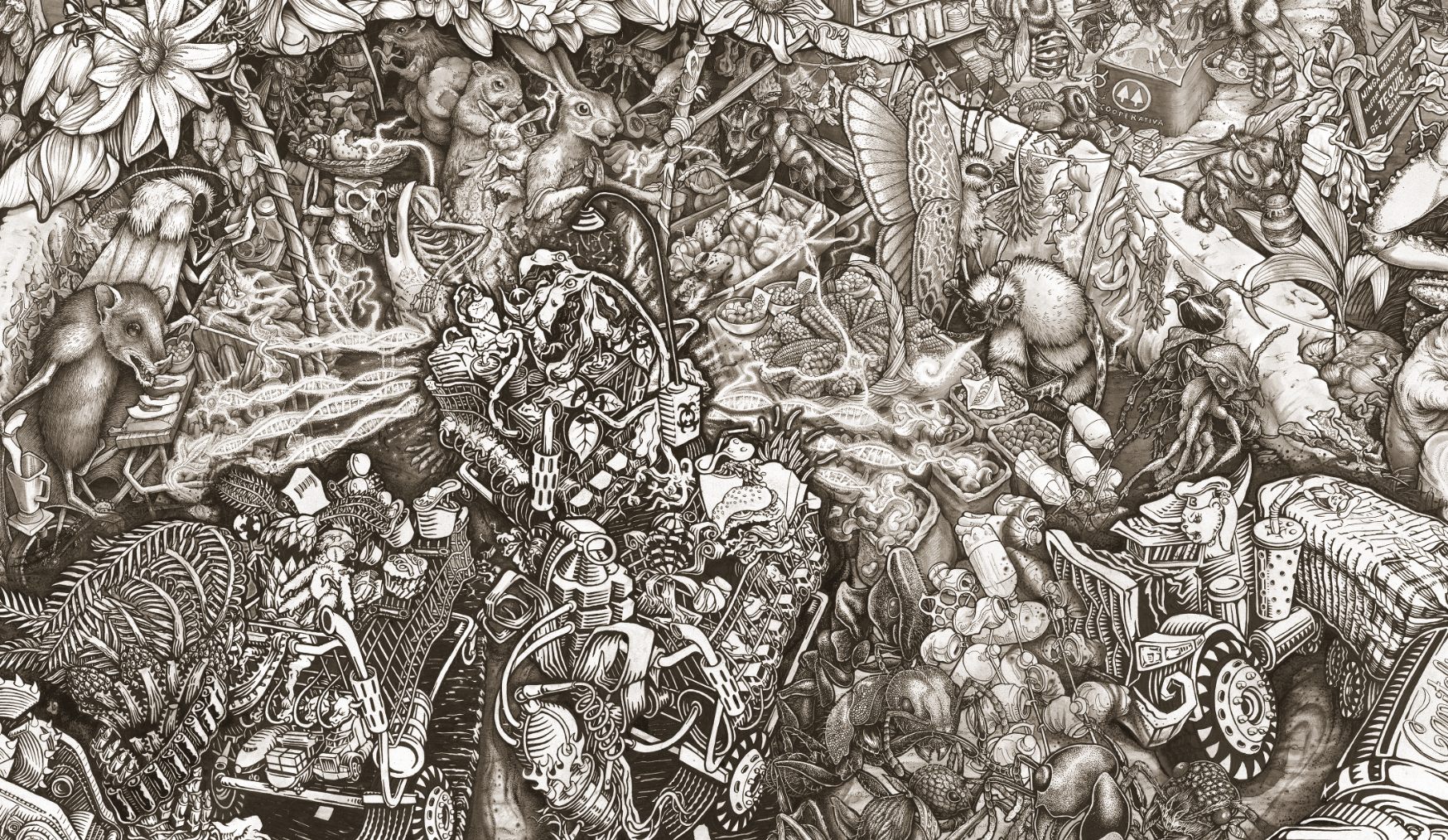 Here, we have a tale of two food systems: one that contributes to the local ecology, and another that depletes soil over time, pollutes nearby water sources, and produces a lot of waste. This also introduces another dynamic of this graphic: on the edges of the graphic you can find figures and metaphors drawn with thicker black and white lines, a shading technique similar to the style used in top-down perspective. These are the invaders, and it is in this space that we showcase scenes of invasion, repression, and of course, resistance.
The Copy Machine
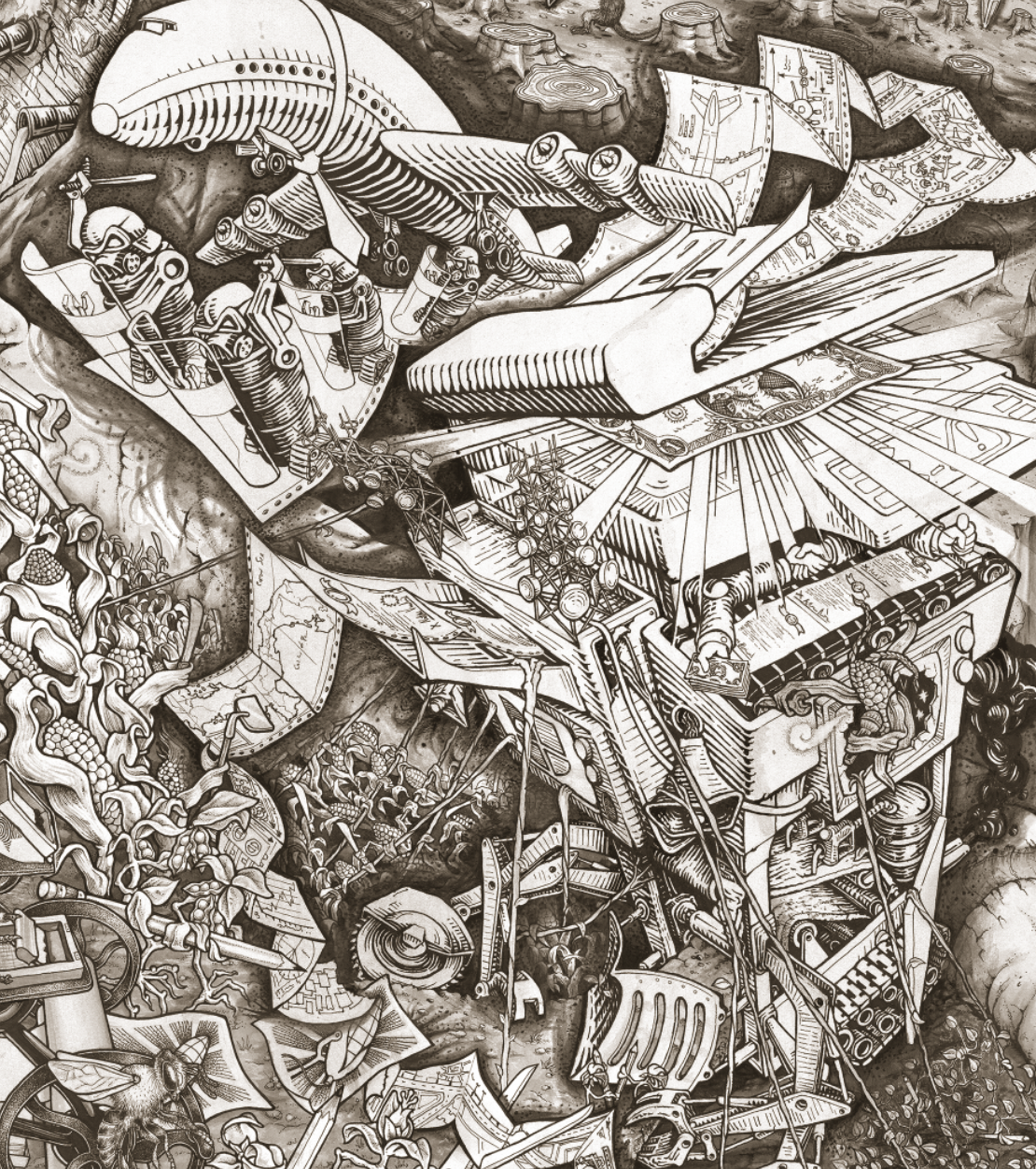 This copy machine is meant to represent the “carbon copy” development plan of Plan Puebla Panama: the idea that if it is river you should dam it, or if it is a mountain you should mine it – in essence it is the idea that there is one path to development, and it happens to be the very fossil fuel-intensive path of industrial development. If you look at the bottom of the copy machine, you see mechanical arms that are cutting and grabbing the land. After displacing the people with cattle catcher, the land is put through a process where it is written on with the oil economy in mind. A conveyor belt takes the plan to completion with hands representing the loan, the deal, and the rubber stamp, while the sheets of copy paper turn into development projects which are met with resistance, like the airplane above and a highway below.
The farmers of Atenco facing off with plans for an airport
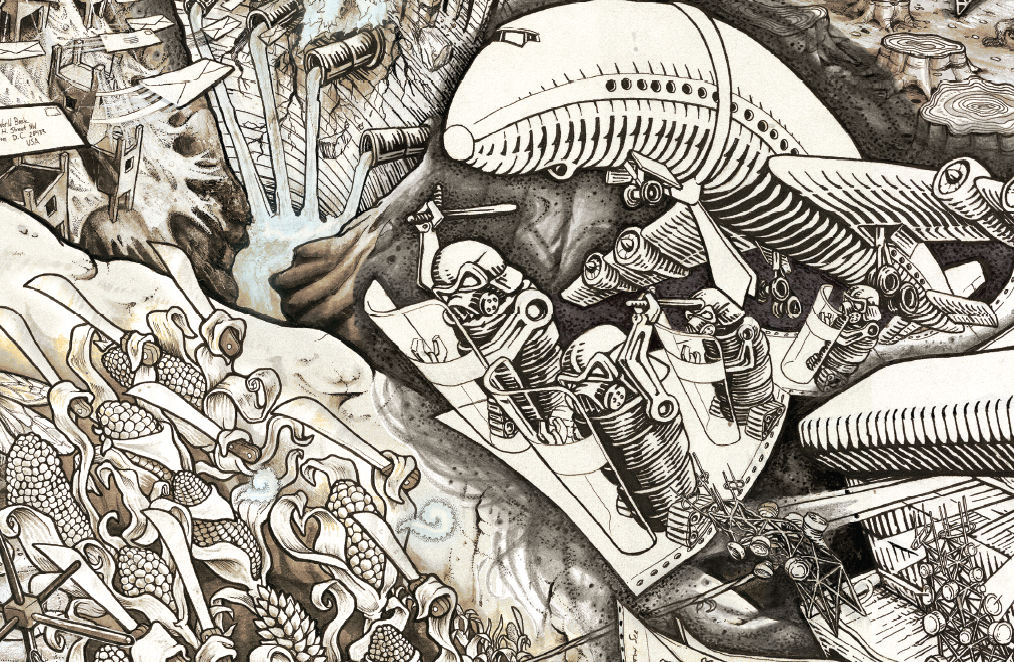 After farmers received notice that a large part of their lands had passed into government hands– without their consent or even consultation – through an eminent domain decree that had, as its goal, the construction of a new International Airport in Mexico, hundreds of townspeople blocked the road between Lechería and Texcoco for various hours on that same morning. They were armed with sticks, stones and machetes, the rural tool that became the symbol of this struggle. The slogan during nine months of conflict was: “We will not give up our land, even if it means giving up our lives.” After several days of fighting the police, the government backed down on its plans, which would have confiscated 70 percent of the land in Atenco and compensated the farmers only 73 cents per meter. The farmers of Atenco would go on to organize against this airport for nearly two more decades, but eventually won against the proposed airport.
The three sisters
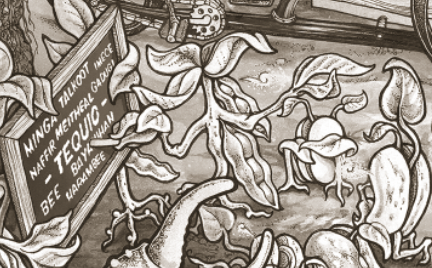 Inspired by the farmer of Atenco who insisted on being represented as corn, the hillside of resistance facing off with the copy machine are animated corn, beans, and squash. These three vegetables are often grown together, representing an Indigenous form of permaculture. Here, they represent farmers, teachers, and labour – a permaculture of social movements. Similarly, these social forces can strengthen each other’s struggles for justice and form powerful social movements.
Other selected scenes:
Women on the Front Lines of Resistance
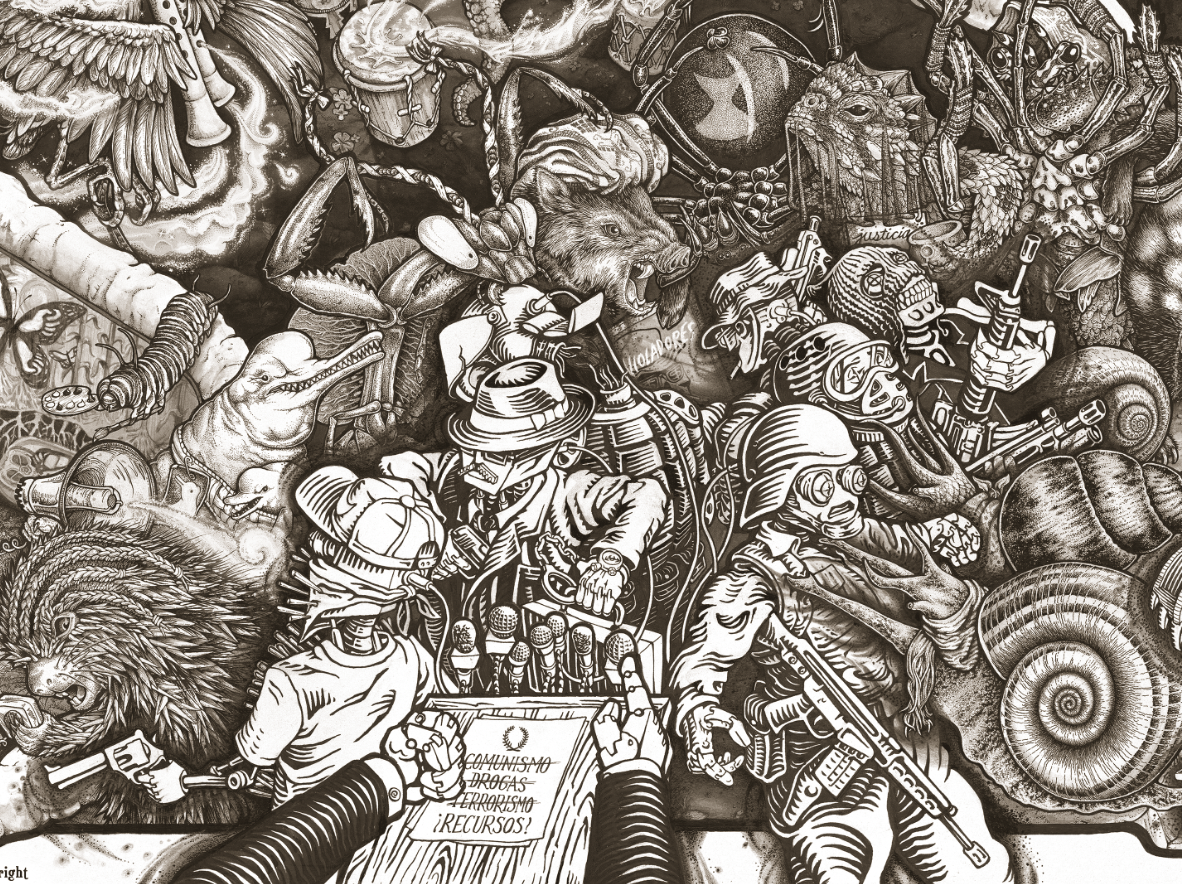 A standoff between military forces and animals representing women illustrates both widespread military aggression against civilians and widespread resistance to it. The use of force against the people has taken many forms throughout the Americas from colonial times to today. The characters here illustrate the different faces of repression on the ground: military from the South, military from the North, death squads, private security forces, militarized riot police, organized crime (‘drug lord’s little helper’), plainclothes paramilitary, whose face is full of porcupine quills. These military characters all have cables plugged into the backs of their necks, connecting them to a podium where a Dr. Claw-like character is giving a press conference (it looks like he is addressing the
UN). On his cheat-sheet are written all of the excuses for military intervention in Latin American governments post WW2. First, communism, or the Cold War, which justified toppling democratically-elected leftists leaders, creating power vacuums filled by repressive right wing regimes. Next, the war on drugs, which justified billions of military aid to countries like Colombia and Mexico, who use their military against their own people. Then, the war on terror, which justified the transfer of surveillance technology and the militarization of borders. The last word is not crossed out and reads “Recursos” or resources, and is the true reason that the US has vied for control of the
region.
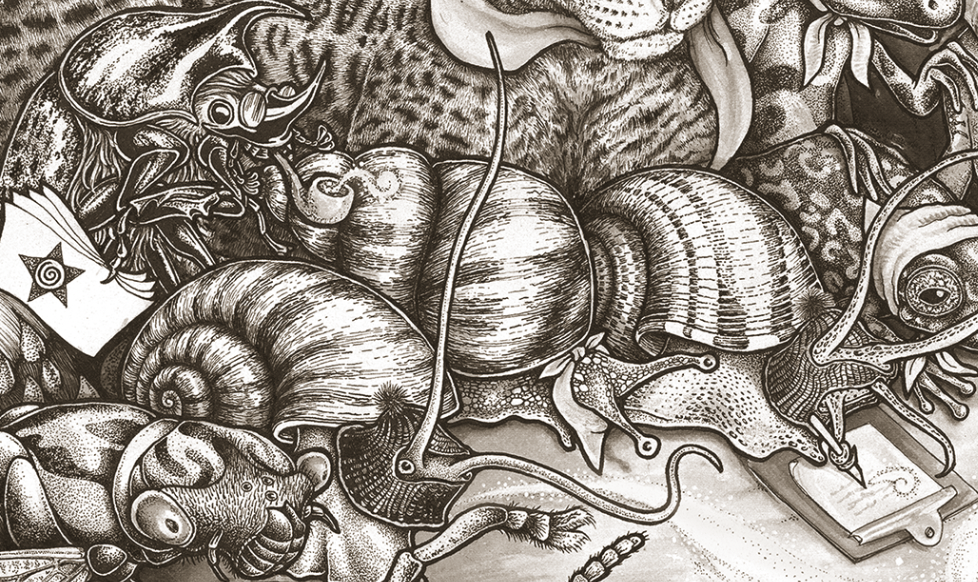
Now unable to advance, the invaders find themselves surrounded by a blockade of women defending their land, safety and community. Each character has a detail to describe her as a woman and/or the creatures are using their natural defences.
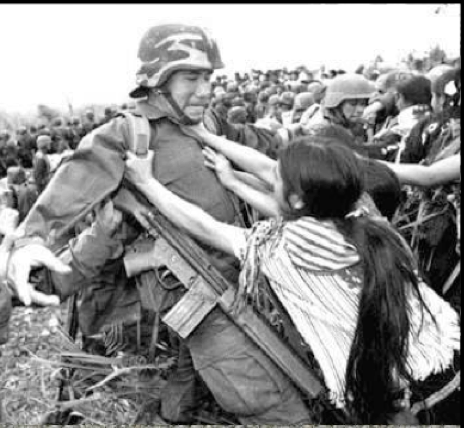 Part of this scene, where the snails are pushing back the soldier, was inspired by an image of a standoff between a military instalment and refugee camp in Chiapas. In this and many other instances, women and children put themselves on the front lines of people trying to push back military forces from advancing on them. While drawing on a specific incident for the imagery, this scene represents many standoffs between armed forces and unarmed civilians in defence of their communities.
Birthing Scene
A trickle of water spills into the pond from a neighbouring cave. Buried deep inside the Ceiba tree’s roots, this cave symbolises fertility, the womb, water source and life source. Inside the cave, new life emerges. A vampire bat midwife assists the home birth.
Midwives are one of many examples of community based alternatives to the practice of Western medicine that treats pregnancy as a medical problem. Pressure to conform to hospital birth and medical treatments dominated by pharmaceutical drugs reinforces this mind-set and plays a part in marginalising and discrediting the practice of traditional and indigenous Medicine. This scene is symbolic of the diversity of medicine, health and healing practices struggling to stay alive. The bunches of plants surrounding the cave’s edges are native to Mesoamérica and are sometimes used in traditional practices for fertility and women’s health.
Escaping Violence
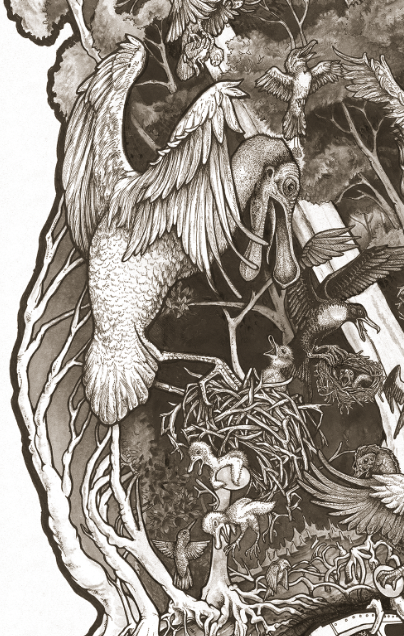 Coming back to the left-hand side, below the Ceiba tree, is a scene of refugee birds being chased from their nest by the bulldozer. Forced to flee, the refugee birds clutch their nests and take flight for the trees. This part of the drawing represents stories of people who survived the war, the scorched earth, the genocide. The broken nests symbolize the destruction and separation of families in exile. In ecological terms, the birds tell a story of habitat destruction caused by construction of infrastructure. Those displaced aren’t only communities of people – but also many other creatures.
Returning refugees
Here you can see some examples of organizing and coming together in solidarity: a childcare cooperative; planting seeds of hope; weaving as a metaphor for bringing people together and the fabric of community; mobilizing and raising awareness through information, petitions and independent media. These birds also symbolize recuperation of historic memory. 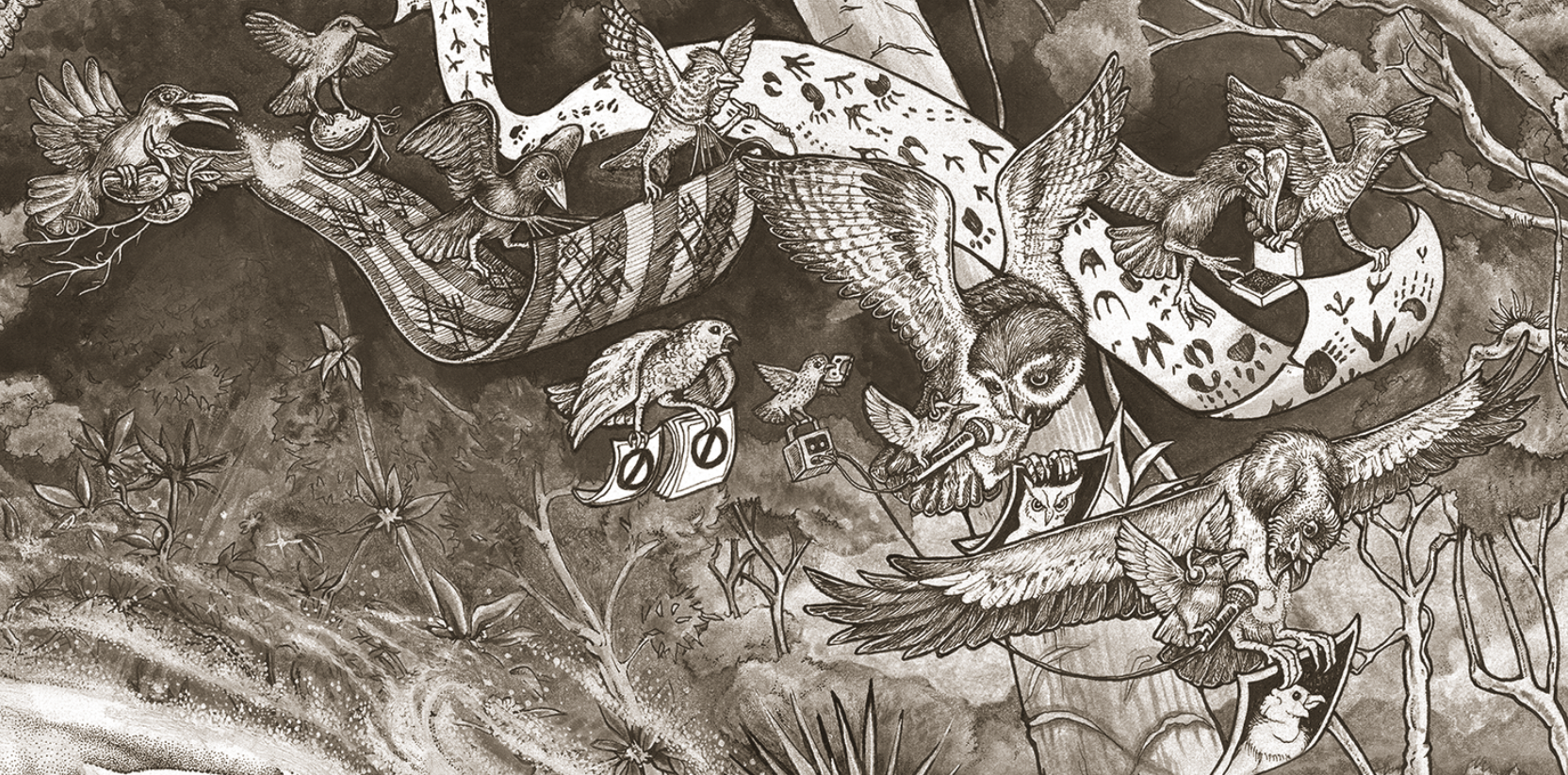 There’s a strong participation of young women – symbolized by the small birds recording interviews with their elders – to remember and keep their history alive. At the front of the line two young birds are flying with the picture of the disappeared.
Super Highways
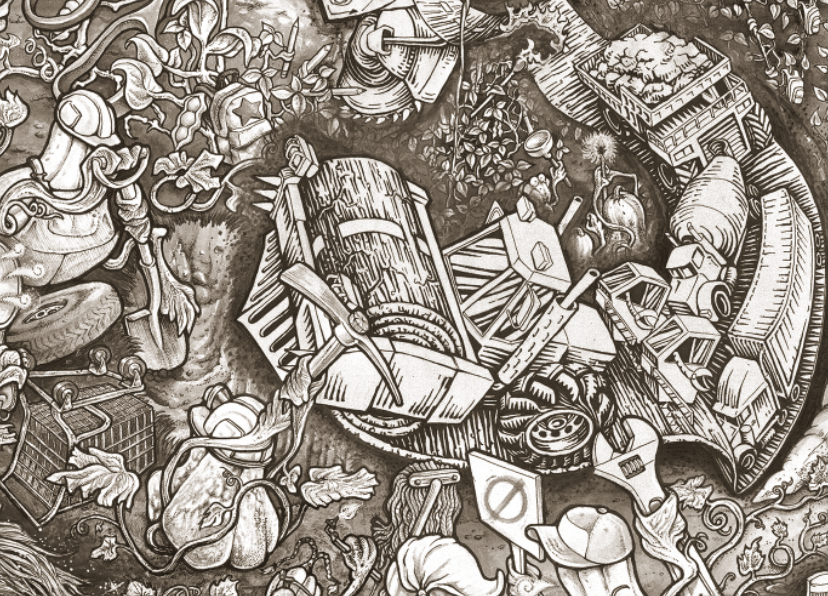 The paper coming out of the Copy Machine is transformed into a super highway. The trucks using the highway represents the types of activity that these highways benefit, including mining, oil, and maquilas. Toll booths are also pictured to show that many of mega-highways have large tolls, further restricting their use.
The invasion of tourism
Some paper from the copy machine morphs into the billboards facing a beach on the coast of Honduras, where a cruise ship with elements of a naval landing carrier is invading the coast of Honduras. Here, the illegal sale of land to tourism companies is at odds with the rights of Garifuna communities already living on the coast who are sustained by the land. Complicity from the government comes in the form of illegal land sales, of ignoring and slowing down First Nations and Garifuna claims to ancestral lands on the coast, and allowing impunity (no punishment) for thugs, paramilitary and death squads who recently and presently terrorise community members, activists, environmentalists and human rights defenders.
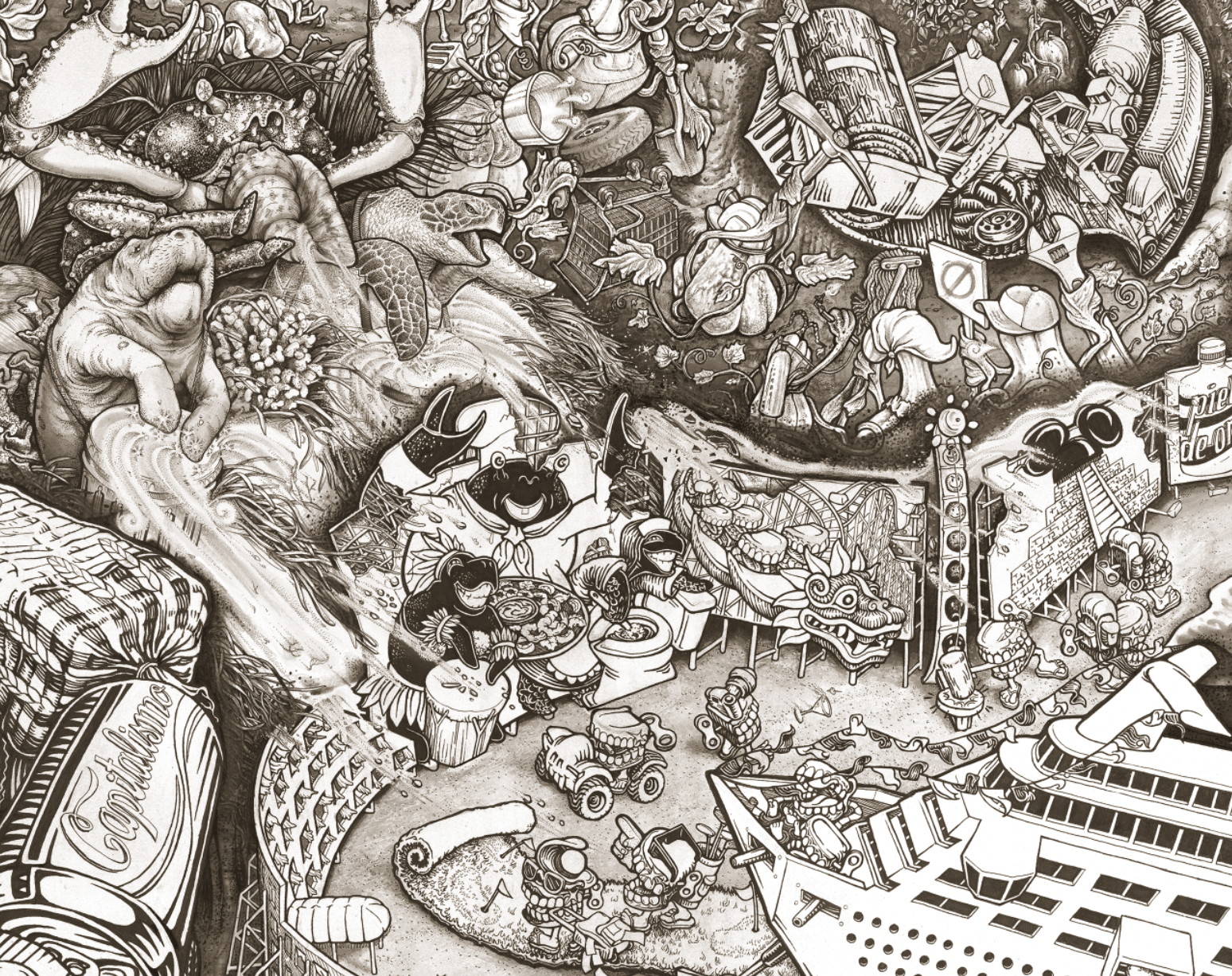 The billboards represent the way the tourists (the wind-up chattering teeth) see the region: the commericalization of sacred sites, the infrastructure catered to their entertainment, and the local Garifuna people working as menial workers and entertainers.
Behind the façade, a manatee, crab and turtle symbolise the resistance of coastal communities. Playing music is part of keeping cultural heritage alive. It is a contrast as to the commodification of indigenous culture by the tourism industry. Noise of the drums, both symbolic and literal, strengthens the voice and visibility of the communities under attack, and is used as a protest tactic of Garifuna fighting for land rights and recognition.
The Solidarity Economy
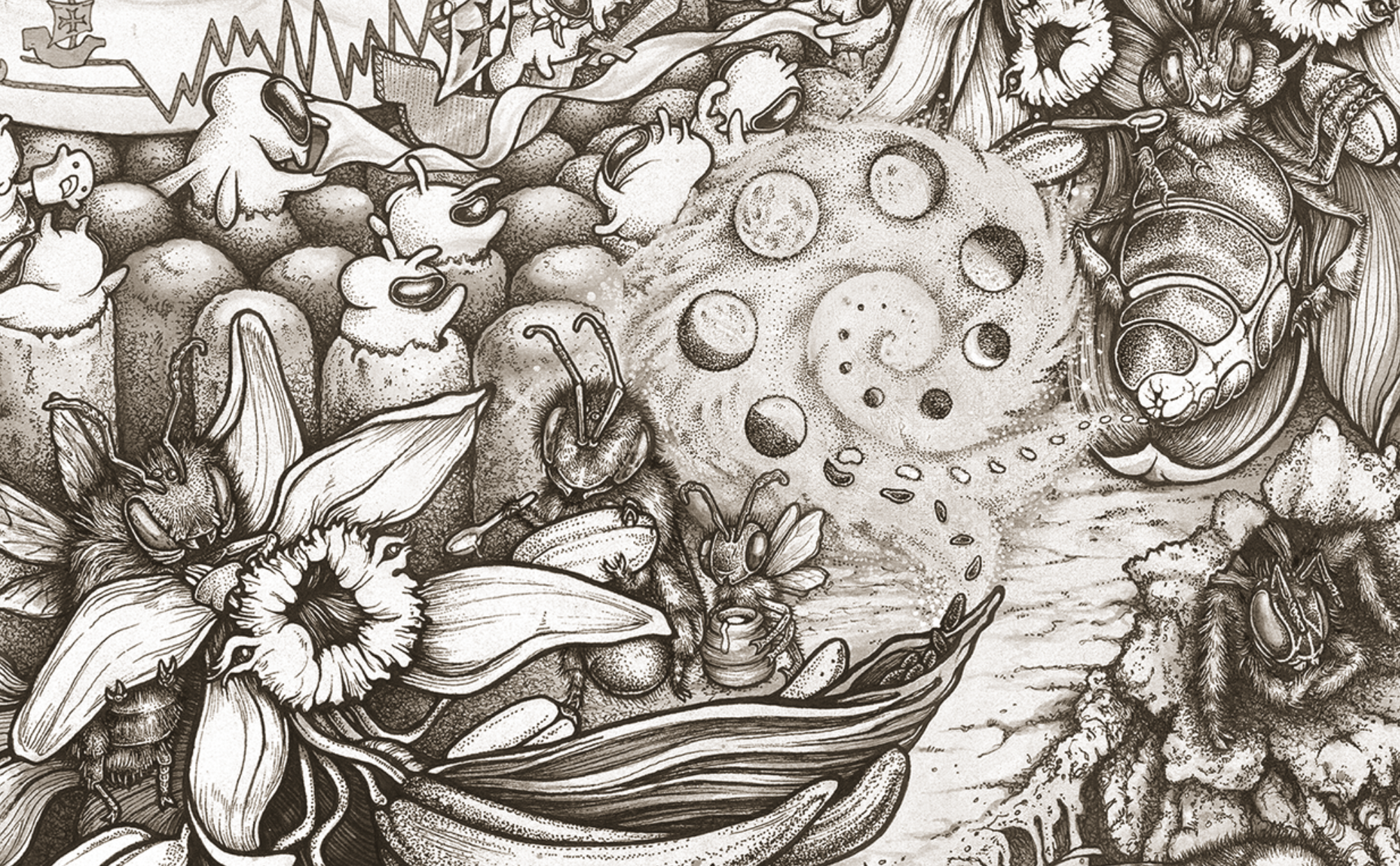 Within the roots of the Ceiba tree, the stingless bees (Melipona) are acting out a detailed scene about solidarity economy. The bee, illustrated alongside the vanilla orchid for which it is the sole pollinator, represents the vital connection between culture and ecology. It is said that the candles made of the wax of the Melipona is the only way to communicate with ancestors, and the bee depends on the Indigenous practice of caring for the logs where stingless bees are kept. Today, deforestation and pollution from chemicals used in farming are the main causes of pollinator collapse, as well as European honey bees commercially replacing stingless bees as a producer of honey.
In contrast to the capitalist economy’s focus on accumulation of financial and material wealth, solidarity economy values well being, culture and healthy ecology. Far from the exploitative and extractive market, the relationships within the solidarity economy are symbiotic and mutually beneficial, like the relationship between the flowers and the bees. Reinvestment in community, childcare, education and seed saving are at the peak of the hive, which cascades down into terraces describing food production and distribution.