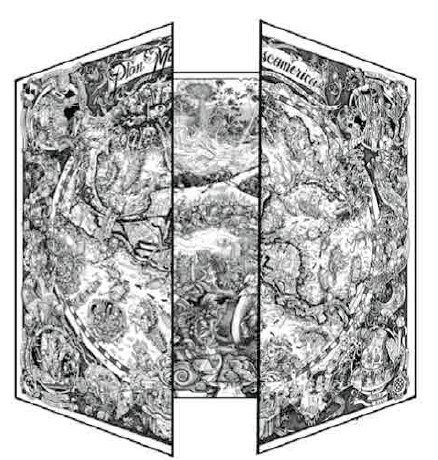
MesoAmérica Resiste is a graphic narrative mural by the Beehive Design Collective. It is the third piece in a trilogy about globalization in the Americas.
MesoAmérica Resiste is a double-sided graphic, to showcase two dramatically different world visions. Outside, we have the view from above, and inside, the view from below.
The View from above
When you look down at the landmass of MesoAmerica (Southern Mexico and Central America) from this perspective, all you can see is the mega-infrastructure projects planned for the region – dams, highways, pipelines, factory zones and airports, etc. It is resistance to these projects that is the theme of the overall piece, specifically a project once known as Plan Puebla Panama.
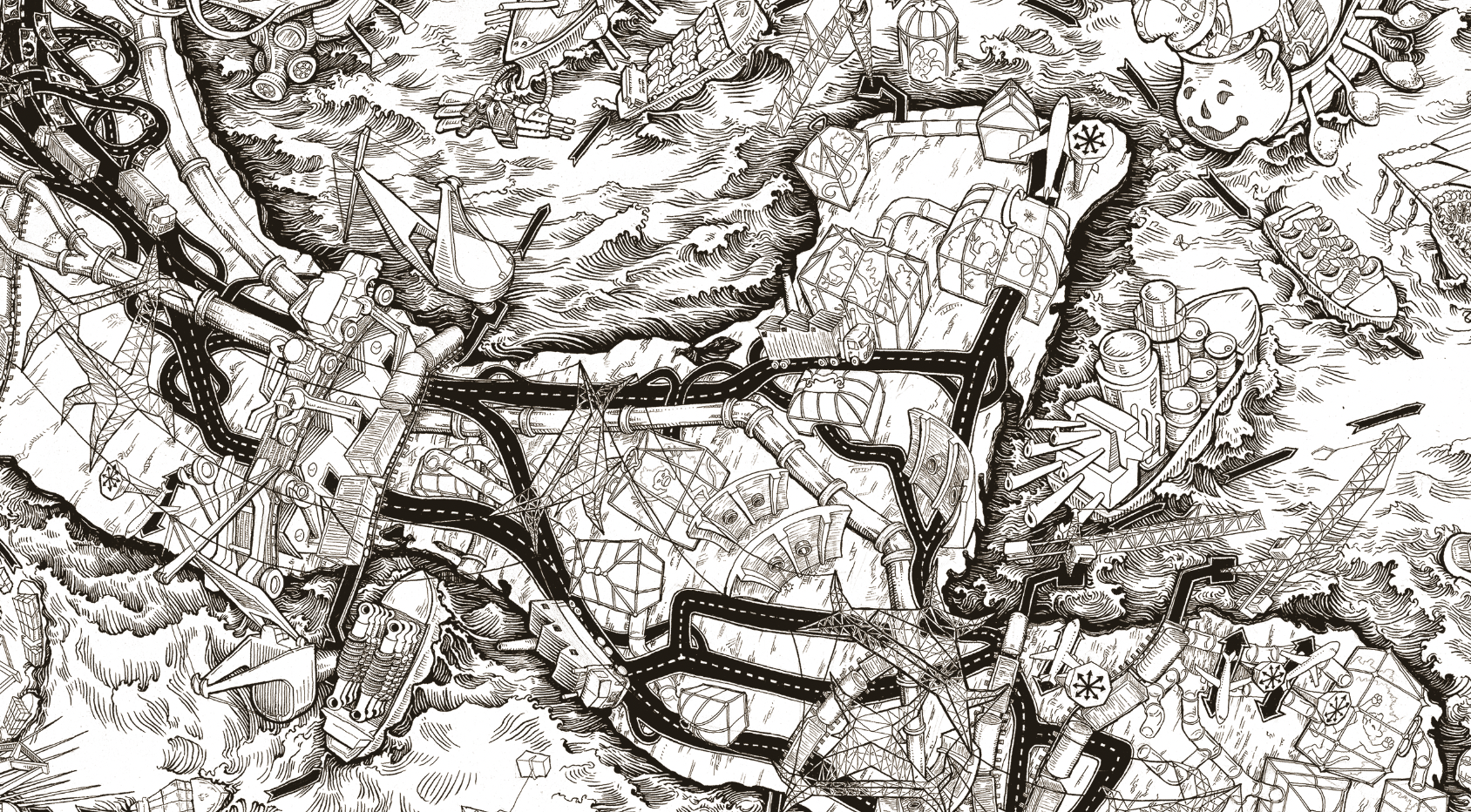
A Capitalist and Colonial perspective
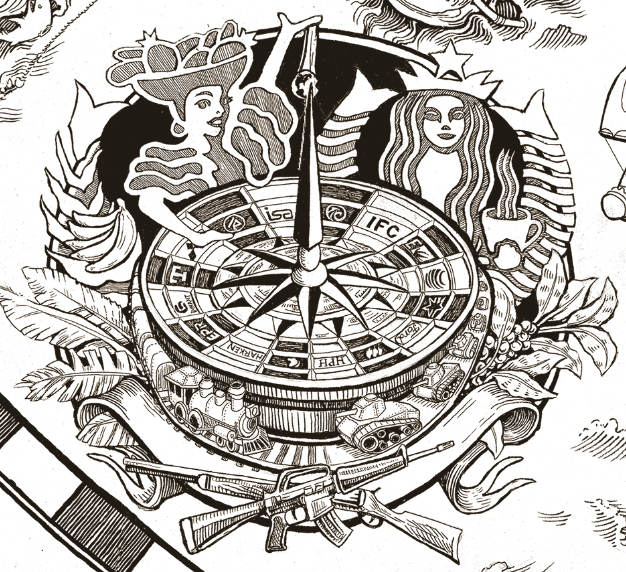 The region itself is drawn as an old world map – an allusion to colonialism. The compass rose features representatives of the coffee and banana industries – two export crops that have had an outsized influence on the region.
The map also serves as an economic snapshot of the region. Boats fill the seas, representing industries – both historic and contemporary – bringing imports and exports to and from the region.  These boats are pushed and pulled by the “Trade Winds” located in the cardinal directions, representing an economic pressure system acting on MesoAmerica.
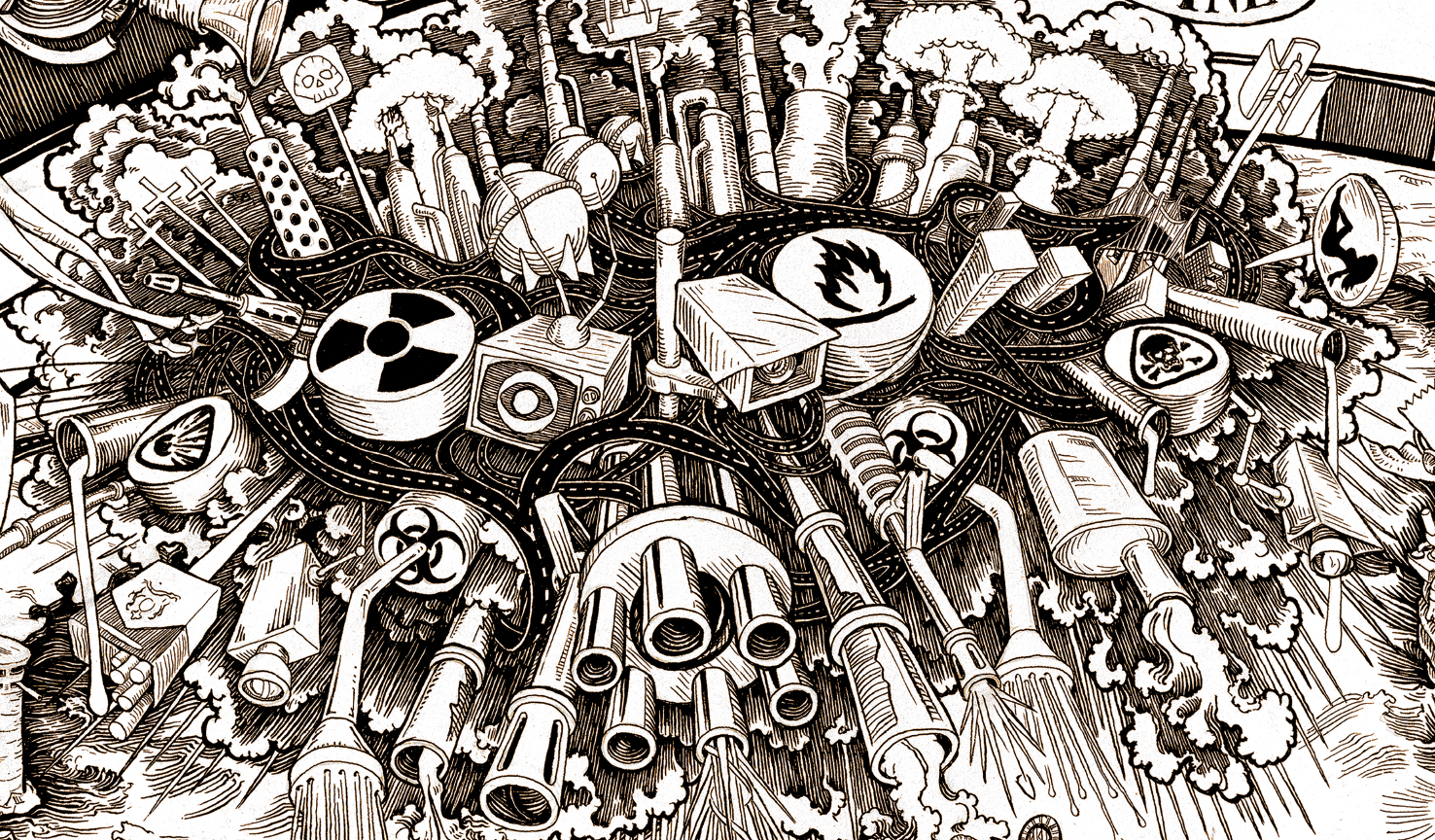
In the north, there is a storm of militarism, pesticides, culture, technology and emissions raining down on the region. Whereas in the south, a hurricane is brewing: unnatural disaster due to climate change, war, economic and industrial displacement is causing a wave of migration north. From Asia, there is a manufacturing cloud of parts destined for MesoAmerica’s factory zones, only to be sucked up by the “Consumer Tornado” to bring to international markets.
Institutions of the Global Economy
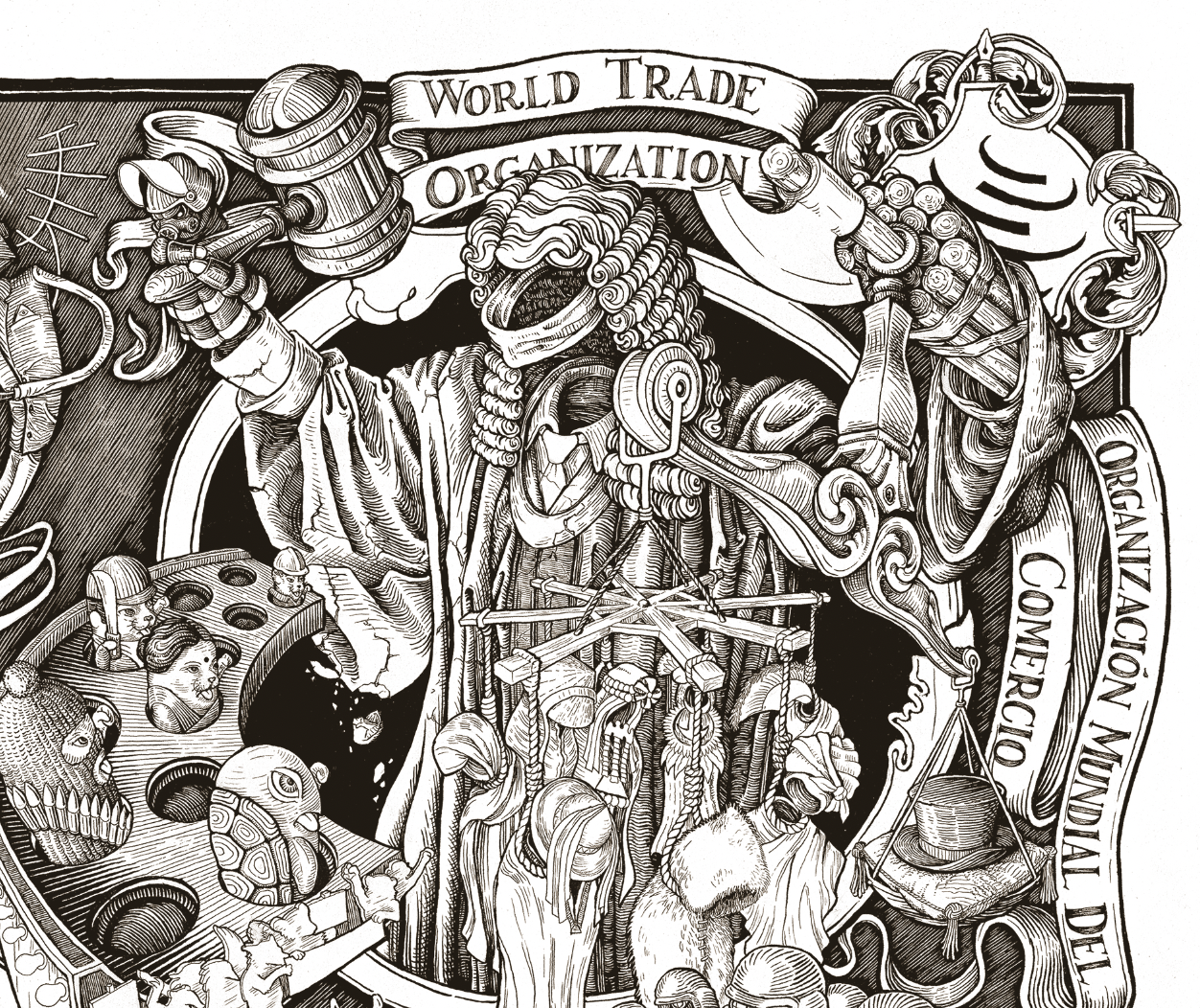 The World Trade Organization (WTO) is depicted as a faceless judge – an allusion to the tribunals set
up by the WTO to settle trade disputes.
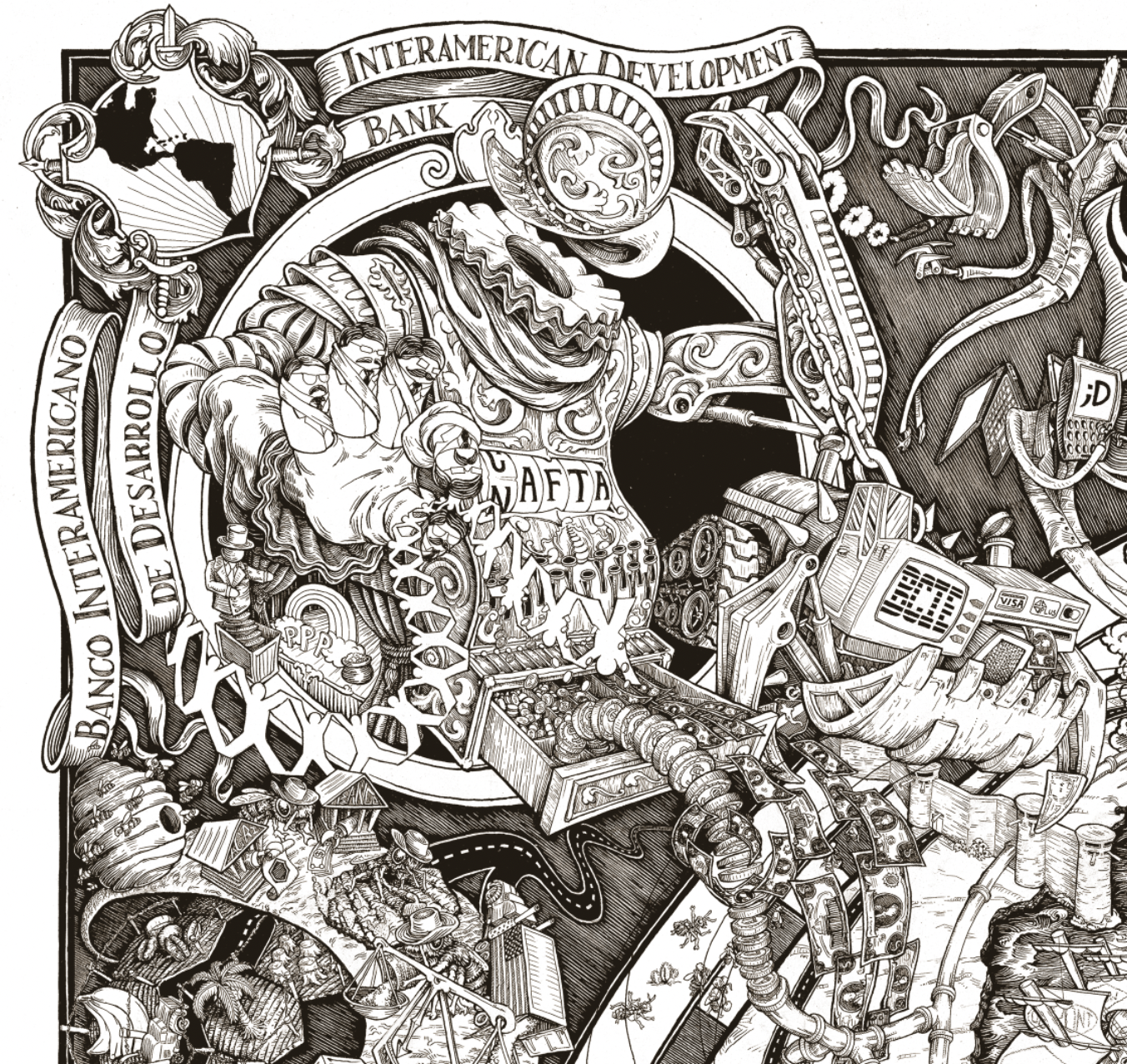 The top right side of the posters shows the InterAmerican Development Bank (IDB) as a conquistador
cash register. The finger-puppet politicians are shaking down the people to fund their massive infrastructure projects that benefit big business.
World Bank and IMF
The World Bank is shown in the bottom left corner as a gambler/vault. With one hand, you can see that he is gambling with climate with the projects it’s investing in. On his gambling table, you can see that he is dealing out chips to various silhouettes of countries and continents. Some have more chips than others, but the smallest stacks of chips have bear traps surrounding them, representing a trap! For poor countries, World Bank loans trap them in poverty to develop large infrastructure like damns and highways.
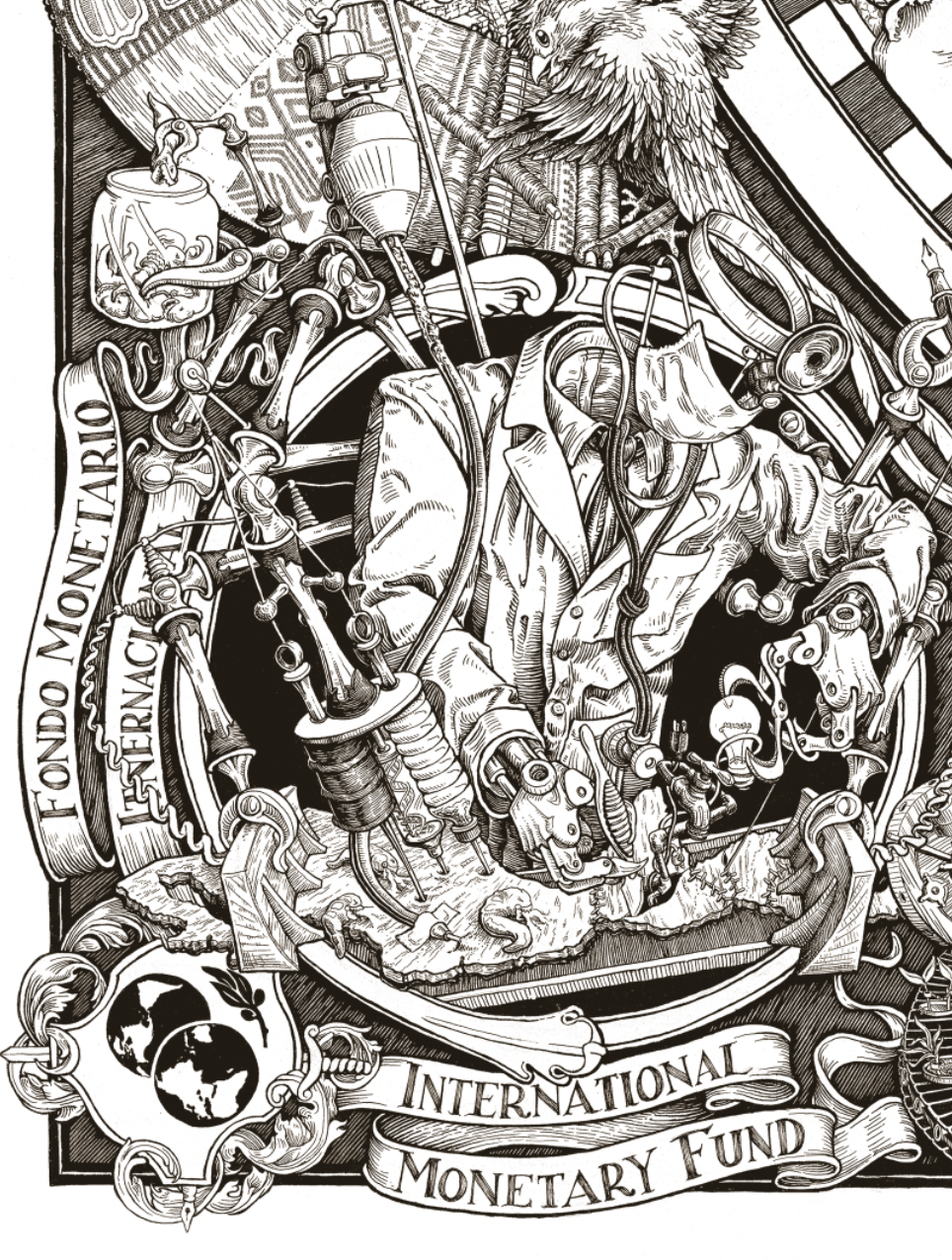 The International Monetary Fund (IMF), which is featured at the bottom left corner of map, depicted as a surgeon who is applying leeches and performing reconstructive surgery on a battered-looking body of MesoAmerica. Stiching up MesoAmérica’s wounds with a fountain pen represents the conditions that the IMF forces countries to accept to have access to loans. A 3-prong syringe represents the privatization of public resources imposed by the IMF. Meanwhile, a knot in the surgeon’s stethoscope illustrates how the IMF is not listening to the hearts of the people they are impacting when it prescribes cutting investment in social services.
MOBIUS STRIPS: Strategies of displacement
The east and west sides of the top-down perspective feature four mobius strips, or infinite loops, representing vicious dynamics at play within MesoAmerica. Each loop represents a strategy of displacement.
The privatization of the commons
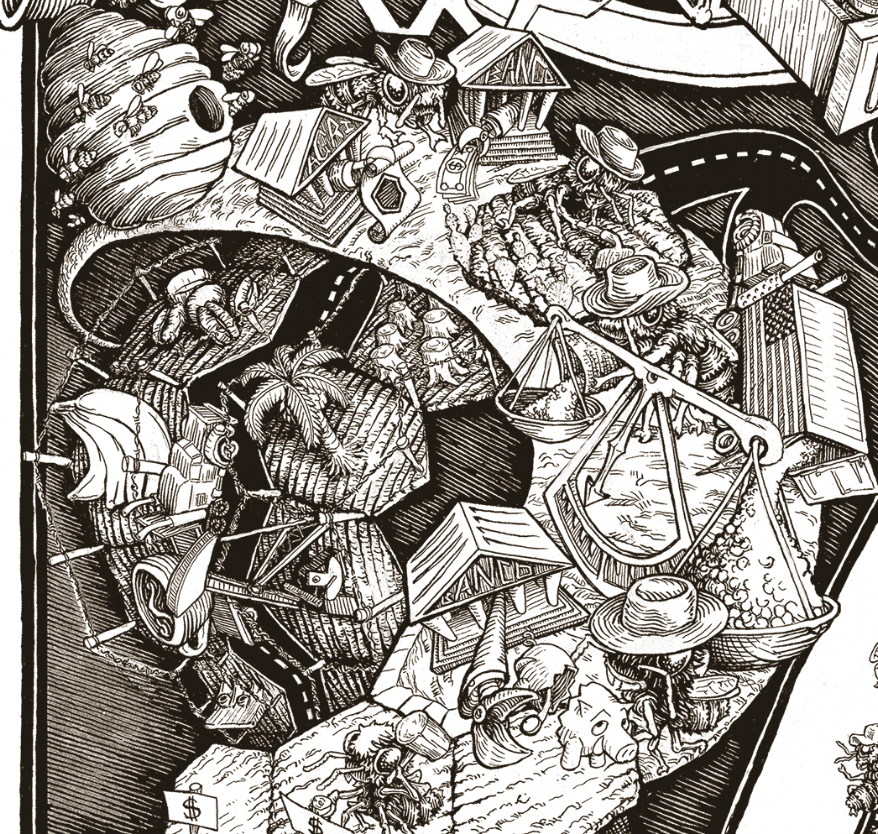 On the left-hand side of the map, we have a mobius strip representing the privatization of collectively owned land. This beehive is meant to represent collectively held lands. In Mexico they were called Ejidos, and they were a gain from the Mexican revolution, whose motto was: land & liberty.
But, NAFTA, or the North American free trade agreement, forced a change to the constitution of Mexico to allow for the subdivision of the ejidos. So, here, farmer bee gets a deed to his very own hexagon of land, and with that deed gets a loan from the bank. There he is proudly farming his own hexagon of private land. But the fruit of his labour can’t compete with subsidised imports coming in from the US. The truck with an American flag on it is “grain dumping”, or selling grain – in this case GMO corn– at below market value because the farmer that grew it received free money from the US government in the form of subsidies.
Farmer bee can’t compete with grain that is sold below cost, so they are forced to sell their land and go into migration, where they either end up migrating to a city to work in a sweatshop, or they migrate north to work on other people’s farms in the US and Canada under highly exploitative migrant worker programs or as “illegals”. Now, the serger machine is sewing barbed wire onto all of the newly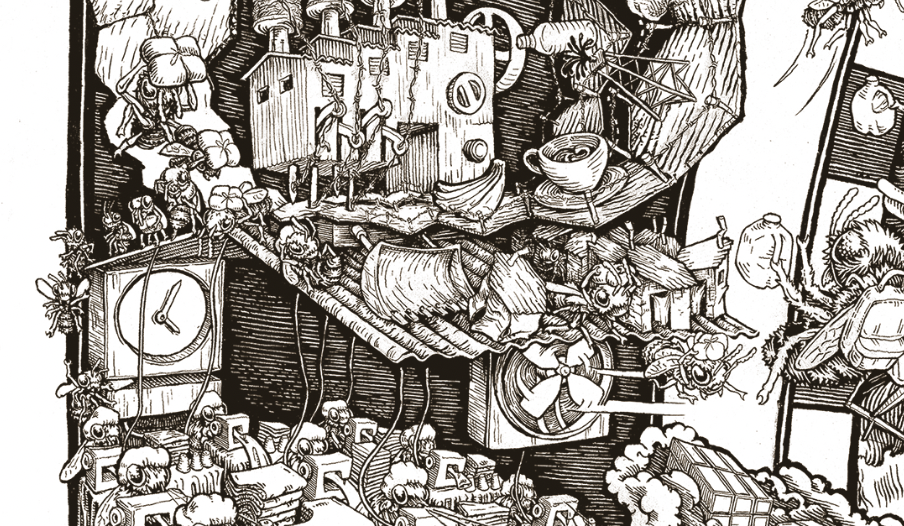 privatised and now consolidated hexagons of land, which is used for cash crops like bananas, coffee, palm plantations and livestock. And through it all, a mega highway to deliver these goods for export to international markets.
Cultural Imperialism
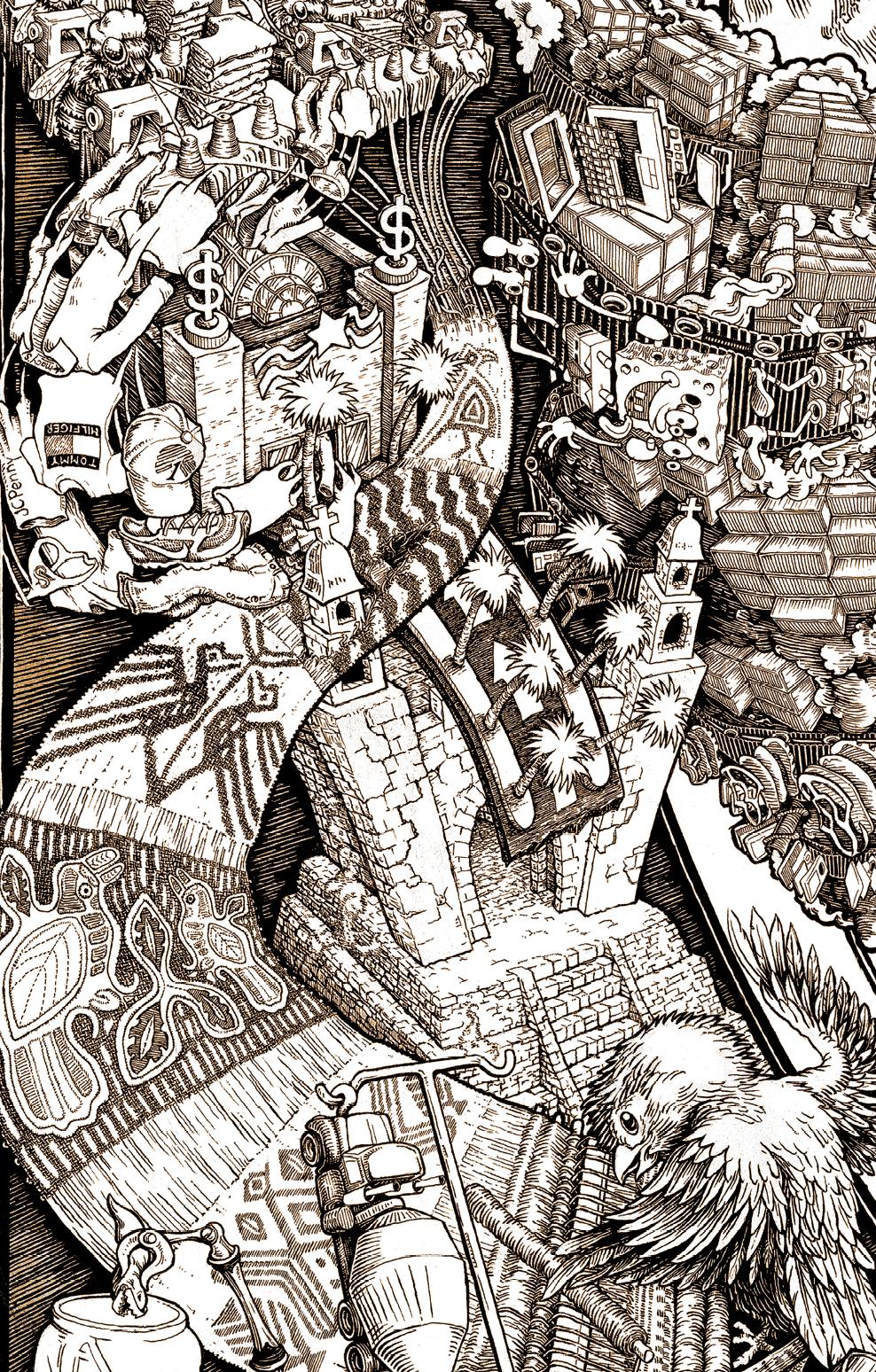 The sweat-shop scene connects to the mobius strip underneath it. Here, a quetzal bird is weaving a bird-motif tapestry (something culturally significant to itself)… that is being frayed, first by this church, and eventually the tattered fabric is fed into the spools of the sewing machines. Out of the sewing machines are name brand clothing that are flying into a mall that is built on top of a church that is built on top of a pre-colombian temple, to represent the various stages of cultural imperialism in the region. This metaphor is quite literal as well, as many of the churches in Mesoamerica were built on top of pre-existing temples, many times using the same stones.
READ a selected synopsis of the Grassroots perspective here.